Turkey Tail Mushroom
Turkey Tail's PSK extract has over 25 controlled human trials in Japan as a cancer adjuvant, more evidence than most functional mushrooms; but those trials used 3 grams per day of a pharmaceutical-grade extract, roughly 6 times a typical US retail capsule's dose, so trial results don't automatically apply to whatever's on a store shelf.
What the research shows
Turkey Tail (Trametes versicolor, also sold as Coriolus versicolor or Yun Zhi) is the source of two protein-bound polysaccharide extracts studied separately in different countries: PSK (polysaccharide-K, brand name Krestin), developed in Japan, and PSP (polysaccharopeptide), developed in China from a different fungal strain. PSK has been used as an adjuvant to standard chemotherapy in Japan since the 1970s and has real trial data behind it. Per Nakazato et al., 1994, The Lancet, a randomized trial of 262 gastric cancer patients who had curative gastrectomy found that adding PSK (3 g/day) to standard chemotherapy improved 5-year disease-free survival (70.7% vs. 59.4%, P=.047) and 5-year overall survival (73.0% vs. 60.0%, P=.044) compared to chemotherapy alone. Per the National Cancer Institute's PDQ summary, a larger follow-up (Toge & Yamaguchi, 2000, 751 patients) found a similar benefit in a specific immune-marker subgroup (68.7% vs. 55.4% 5-year survival, P=.007), and a 2007 meta-analysis of 8 gastric-cancer trials covering 8,009 patients found an overall survival hazard ratio of 0.88 favoring PSK. Colorectal and lung cancer trials show similar adjuvant-therapy benefit patterns.
The dose gap matters. The trials above used PSK at 3 grams per day, a pharmaceutical-grade extract administered alongside chemotherapy under medical supervision in Japan, where PSK is an approved drug. A typical US retail Turkey Tail capsule delivers roughly 500 mg per day of a generically standardized extract, not the specific PSK preparation used in these trials. This isn't a reason to dismiss the research; it's a reason not to treat a supplement label as equivalent to what was tested.
PSP and gut health: a smaller, different body of evidence
Per Pallav et al., 2014, Gut Microbes, a randomized trial gave 24 healthy volunteers either PSP, amoxicillin, or no treatment for 8 weeks. The PSP group showed a prebiotic-like effect: increased Bifidobacterium and Lactobacillus species, and decreased Clostridium, Staphylococcus, and Enterococcus species. This is a small, short trial in healthy adults, not a clinical outcome study, and it used PSP specifically, not PSK or a generic fruiting-body extract.
Fruiting body vs. mycelium-on-grain: the same disclosure gap as other species
Per Nammex's published Megazyme-assay testing data, the fruiting-body-vs-mycelium distinction that matters across this site's Lion's Mane and Cordyceps coverage applies to Turkey Tail too, though the mechanism is concentration rather than a hard compositional ceiling like Chaga's.
| Source type | Compounds | What lab data shows | Label example |
|---|---|---|---|
| Whole fruiting body extract (hot water) | PSK/PSP protein-bound polysaccharides, beta-glucans (an immune-supporting carbohydrate, 30-45% in tested extracts) | Per Nammex's published Megazyme-assay testing, clean fruiting-body extracts consistently test at 30-40% beta-glucans. Nootropics Depot's own product page states a minimum 45% beta-glucan standardization for its fruiting-body extract. | A label stating "fruiting body," "hot water extract," or a specific beta-glucan percentage indicates this type. |
| Mycelium grown on grain (rice/oat) | Mostly starch from the grain substrate; low beta-glucan concentration | Per the same Nammex testing data, mycelium-on-grain products test at only 5-7% beta-glucans, sometimes as low as 1%, because the grain substrate can't be separated from the mycelium and makes up much of the finished product's weight. | A label saying "mushroom mycelium" or naming rice/grain as a growing substrate, with no beta-glucan percentage stated, is very likely this type. |
For dosing detail and how the trial dose compares to typical retail servings, see Turkey Tail Dosage & Consumption. Turkey Tail is also compared against Chaga, Cordyceps, Reishi, and Lion's Mane research on the Chaga hub, Cordyceps hub, Reishi hub, and Lion's Mane hub.
Named brands, checked one at a time
Beyond the source-material comparison above, named brands get a dedicated look at what their own label discloses.
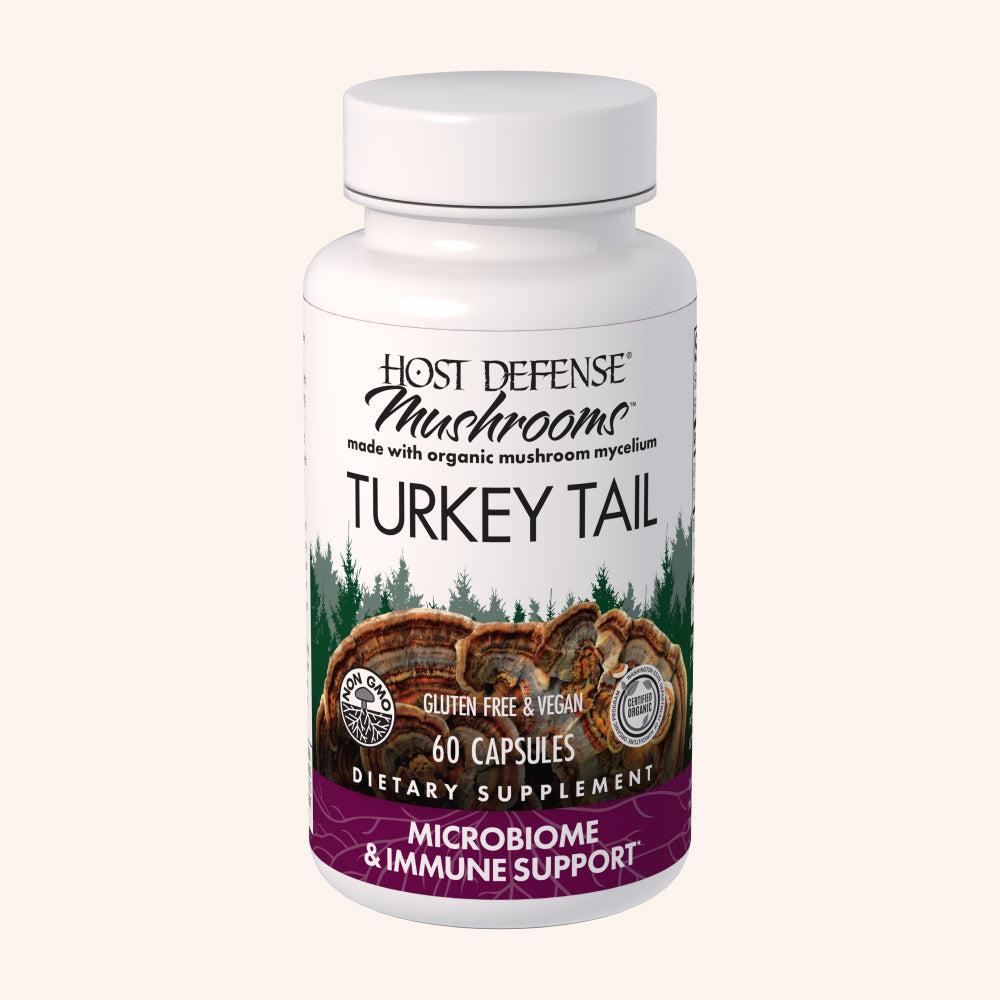
Host Defense
Mycelium grown on fermented rice, no beta-glucan percentage or PSK/PSP content published.
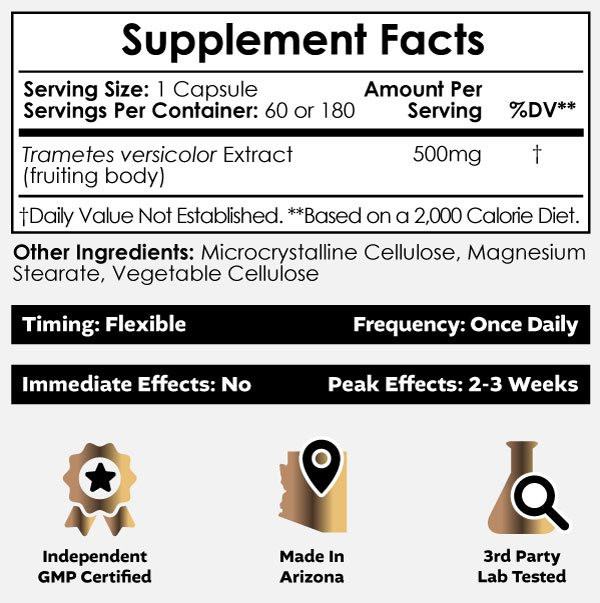
Nootropics Depot
Whole fruiting body, hot-water extracted, brand-guaranteed minimum 45% beta-glucans, brand says PSK/PSP preserved, third-party ISO-lab tested.
NOW Foods
Label discloses both fruiting body and mycelial biomass, but no beta-glucan percentage or PSK/PSP content published.
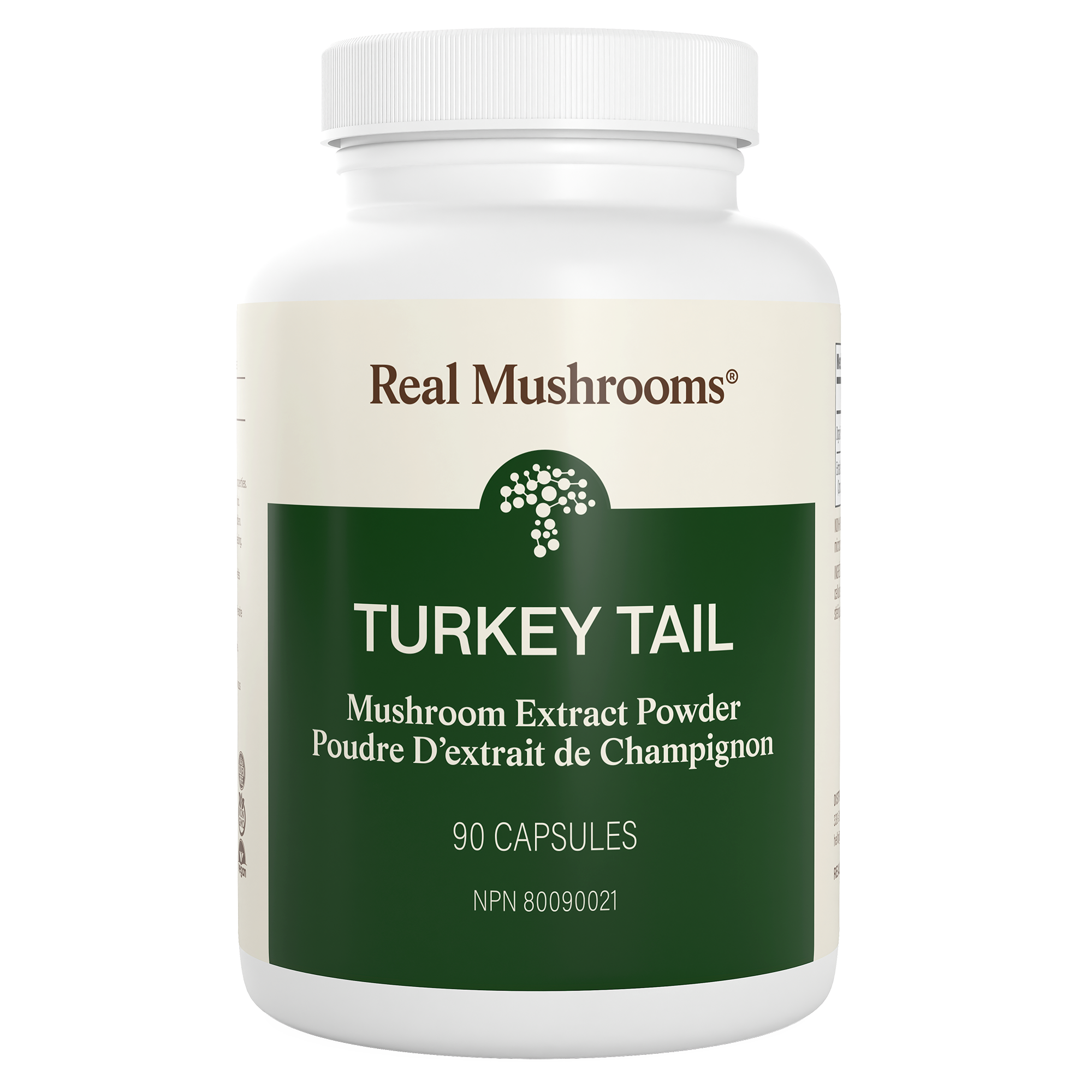
Real Mushrooms
100% fruiting body, hot-water extracted, brand guarantees >30% beta-glucans, brand says NMR species-verified.
Ways to take it
Turkey Tail shows up in several formats beyond capsules: mushroom coffee blends, gummies, and multi-species blends. Check each format's page for what it discloses; none of them are compared against each other on this page.
Frequently Asked Questions
Sources
- Nakazato et al., 1994, The Lancet: Randomized trial, 262 gastric cancer patients post-gastrectomy, chemotherapy plus PSK (3 g/day) vs. chemotherapy alone; 5-year disease-free survival 70.7% vs 59.4% (P=.047), 5-year overall survival 73.0% vs 60.0% (P=.044)
- National Cancer Institute, Medicinal Mushrooms (PDQ): Health Professional Version: Summarizes Nakazato et al. 1994, Toge & Yamaguchi 2000 (751 patients), a 2007 meta-analysis of 8 gastric-cancer RCTs (8,009 patients, OS HR 0.88), a 2006 colorectal meta-analysis (1,094 patients), a lung-cancer systematic review (6 RCTs), and PSK's safety record
- Pallav et al., 2014, Gut Microbes: Randomized trial, 24 healthy volunteers, PSP vs. amoxicillin vs. control over 8 weeks; PSP increased Bifidobacterium/Lactobacillus, decreased Clostridium/Staphylococcus/Enterococcus
- Nootropics Depot, Turkey Tail Mushroom Capsules product page: Brand's own disclosure of whole-fruiting-body source, hot-water extraction, minimum 45% beta-glucan standardization, and PSK/PSP preservation