Cordyceps Mushroom
Cordyceps' clinical evidence for exercise performance is real but narrow: it improved submaximal exercise thresholds in untrained older adults, not VO2max in already-trained cyclists, and most "Cordyceps sinensis" supplements (including the clinical-trial material itself) are a lab-fermented mycelial strain, not the wild fungus.
What the research measured
A 12-week, double-blind, placebo-controlled trial in 15 healthy older adults (age 50-75) tested 999 mg/day of the Cs-4 fermentation product (333 mg capsules, three times daily), per Chen et al., 2010, Journal of Alternative and Complementary Medicine. Metabolic threshold improved 10.5% (p=0.022) and ventilatory threshold improved 8.5% (p=0.031) versus placebo, but VO2max itself did not change significantly. This was a small trial (only 15 of 20 enrolled subjects completed it), and the authors themselves noted larger studies are needed.
A separate 5-week trial gave the same Cs-4 product at the same 3 g/day dose to 22 endurance-trained male cyclists, per Parcell et al., 2004, International Journal of Sport Nutrition and Exercise Metabolism. VO2peak was statistically unchanged (59.1 to 57.1 mL/kg/min in the treatment group, versus 59.9 to 60.1 mL/kg/min on placebo), and time-trial performance did not differ between groups. Taken together, the two trials point to a population-specific effect: a measurable submaximal threshold change in untrained older adults, and no measurable performance benefit in athletes already near their aerobic ceiling.
"Cordyceps sinensis" on a label rarely means the wild fungus
Wild Cordyceps sinensis is a caterpillar fungus harvested from the Tibetan Plateau; it cannot be farmed at commercial scale. Nearly every "Cordyceps sinensis" supplement on the market, including CordyMax Cs-4, the exact material used in both clinical trials above, is a specific mycelial strain (Paecilomyces hepiali Chen, isolated from wild C. sinensis) grown by tank fermentation. Cordyceps militaris, by contrast, is a different species that fruits normally and can be cultivated directly, which is why C. militaris fruiting-body products can publish an actual cordycepin percentage while fermented-mycelium products typically cannot.
| Source type | Compounds | What brand data shows | Label example |
|---|---|---|---|
| C. militaris, whole fruiting body | Cordycepin (one of Cordyceps' key active compounds), plus beta-glucans (an immune-supporting carbohydrate) when hot-water extracted | C. militaris fruiting bodies contain far higher cordycepin than wild C. sinensis or mycelium-on-grain products, since cordycepin concentrates in the fruiting structure itself, per lab comparisons published across multiple mushroom-extract manufacturers, including Nootropics Depot's and Real Mushrooms' own product pages. | A label naming "Cordyceps militaris" and stating "fruiting body" with a published cordycepin or beta-glucan percentage indicates this source. |
| Mycelial fermentation strain (e.g. "Cs-4") | Variable, strain- and process-dependent | Most "Cordyceps sinensis" supplements, including the CordyMax Cs-4 material used in the clinical trials below, are not the wild caterpillar fungus at all. Cs-4 is a specific mycelial strain (Paecilomyces hepiali Chen) fermented in tanks after being isolated from wild C. sinensis, chosen because wild C. sinensis cannot be commercially cultivated at scale. | A label saying "Cordyceps sinensis" without a species-verification claim or a cordycepin percentage is very likely this fermented-mycelium type, not the wild fungus. |
This isn't a quality judgment against fermented-mycelium products by default; Cs-4 is the exact material both clinical trials above tested. It's a labeling-transparency point: a product that names its species, states fruiting body vs. mycelium, and publishes a cordycepin or beta-glucan figure gives you something checkable against the research doses. One that doesn't, doesn't.
Is it safe?
Per the NCBI Bookshelf (LiverTox), Cordyceps extracts are assigned the lowest likelihood category for causing clinically apparent liver injury, with only one isolated case report (a chronic condition in an 81-year-old after 5 years of use) despite widespread use. Reported side effects are generally mild (GI discomfort, dry mouth, rash). Cordyceps can increase bleeding risk and has an additive effect with blood-sugar-lowering medication; see the Cordyceps Dosage & Consumption page for the specific interaction data. This page does not evaluate other medication interactions; check with a doctor before starting any supplement, especially if pregnant, on medication, or allergic to mushrooms.
For consumption forms and dosing detail, see Cordyceps Dosage & Consumption. Cordyceps is also compared against Reishi and Lion's Mane research on the Reishi hub and Lion's Mane hub. Cordyceps as a coffee-blend ingredient is covered separately on Cordyceps Mushroom Coffee.
Named brands, checked one at a time
Beyond the source-material comparison above, named brands get a dedicated look at what their own label discloses.
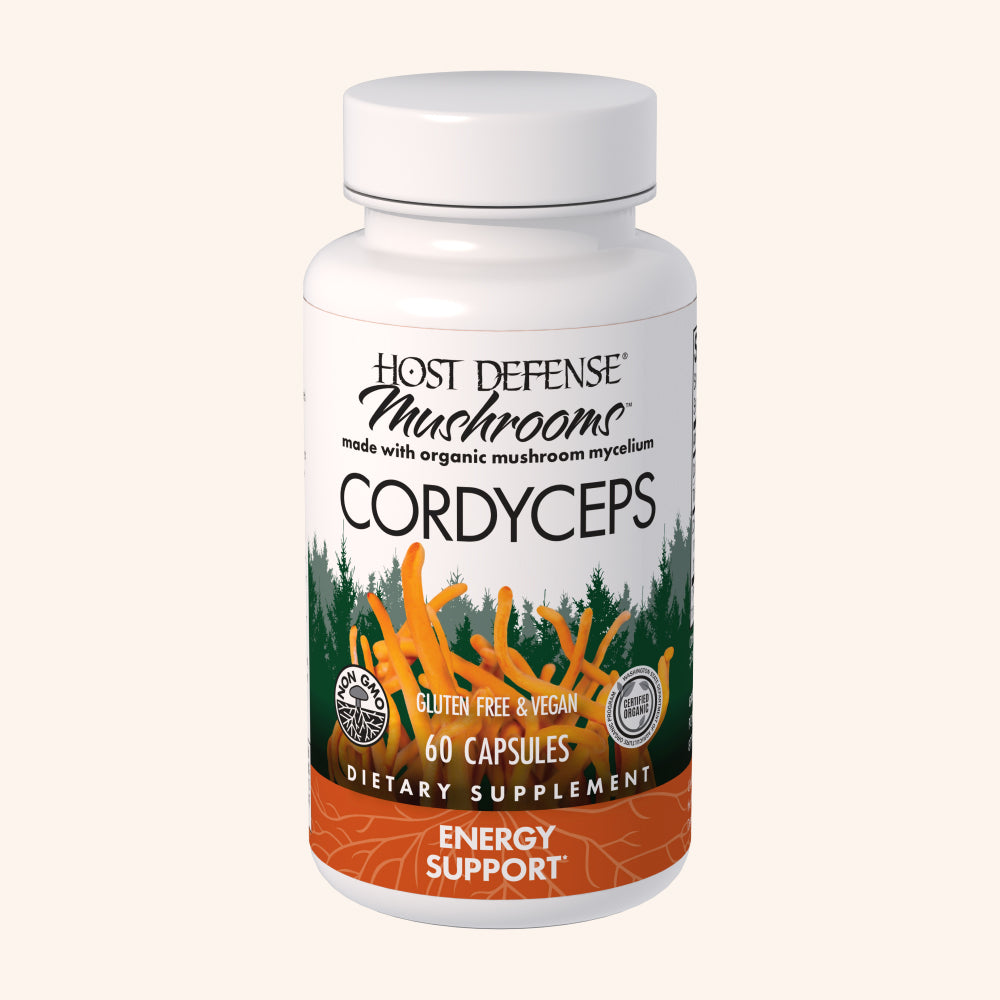
Host Defense
Mycelium grown on fermented rice, no cordycepin or beta-glucan percentage published.
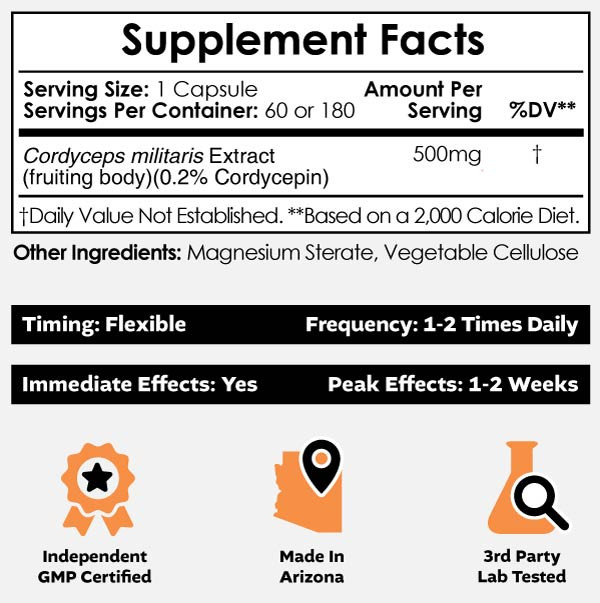
Nootropics Depot
C. militaris whole fruiting body, hot-water extract, brand says HPLC-verified 25% beta-glucans and 0.2% cordycepin.
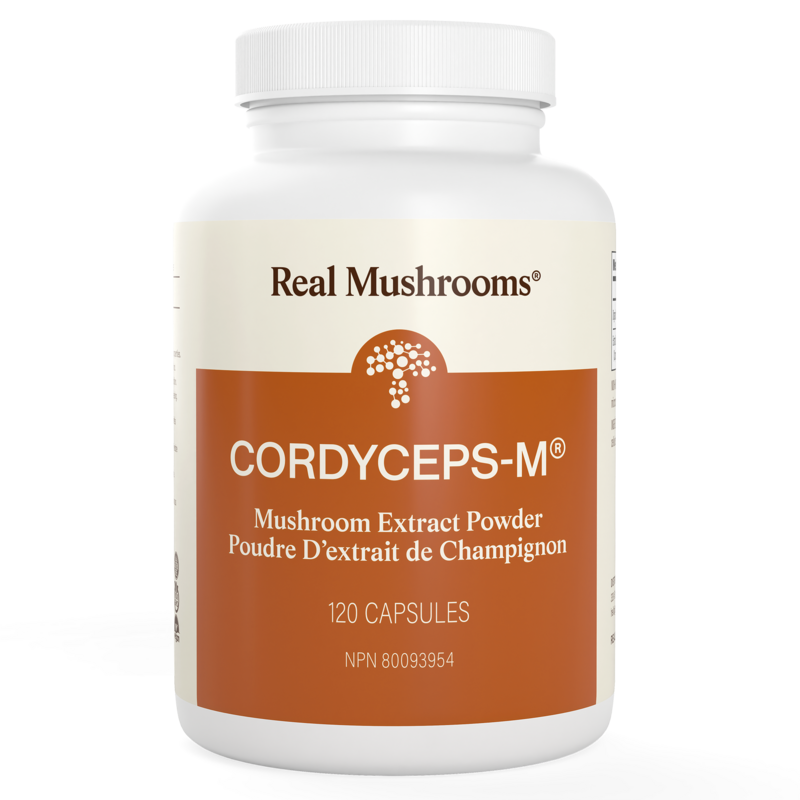
Real Mushrooms
C. militaris fruiting body, brand says NMR species-verified, brand guarantees >30% beta-glucans.
Ways to take it
Cordyceps shows up in several formats beyond capsules: Cordyceps coffee, chocolate, gummies, and multi-species blends. Check each format's page for what it discloses; none of them are compared against each other on this page.
Frequently Asked Questions
Sources
- Chen et al., 2010, Journal of Alternative and Complementary Medicine: Double-blind, placebo-controlled trial: Cs-4 999 mg/day (333 mg x3) for 12 weeks in healthy adults 50-75 (n=15 completed); metabolic threshold +10.5% (p=0.022), ventilatory threshold +8.5% (p=0.031), VO2max not significantly changed
- Parcell et al., 2004, International Journal of Sport Nutrition and Exercise Metabolism: Randomized, double-blind trial: CordyMax Cs-4 3 g/day for 5 weeks in 22 endurance-trained male cyclists; no significant change in VO2peak or time-trial performance
- NCBI Bookshelf, LiverTox: Cordyceps: Clinical safety review; likelihood category E (unlikely cause of clinically apparent liver injury), one isolated case report
- Nootropics Depot, Cordyceps militaris Whole Fruiting Body Extract product page: Brand's own disclosure of fruiting body source, hot-water extraction, and HPLC-verified beta-glucan/cordycepin standardization
- Real Mushrooms, Cordyceps-M Extract Capsules product page: Brand's own disclosure of fruiting body source, hot-water extraction, and guaranteed beta-glucan content