Mushroom Coffee
Mushroom coffee blends ground coffee with powdered mushroom extract, usually Lion's Mane or Chaga, and brands disclose what's in the blend very differently: some publish exact milligrams per species, others publish only a total blend weight across several species combined.
What's in the blend, brand by brand
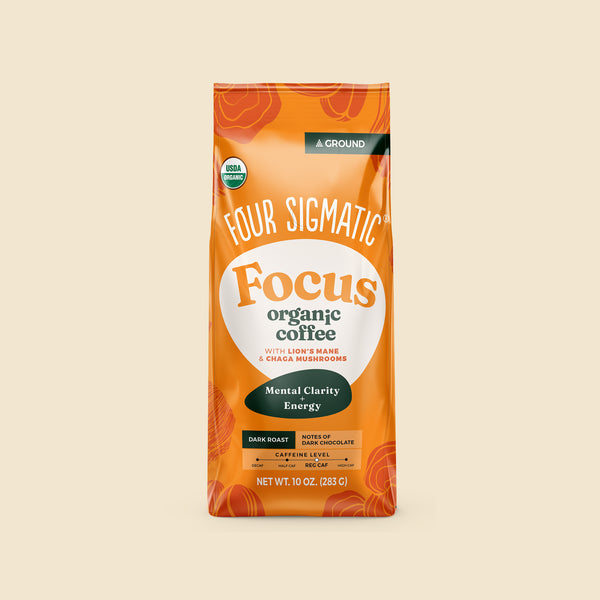
The label is the whole story here. Four Sigmatic's Focus blend states its Lion's Mane and Chaga come from fruiting bodies only, with "no fillers, grains or carriers," and lists 250 mg of each extract per serving. Ryze's Mushroom Coffee discloses a 2 g total "Super6" blend across six species (Cordyceps, Reishi, Turkey Tail, King Trumpet, Shiitake, Lion's Mane) per serving, but does not publish how that 2 g splits between species, so no single mushroom's dose can be read off the label.
Four Sigmatic
Fruiting body only, stated on the label, 250 mg each of Lion's Mane and Chaga extract per serving.
Ryze Mushroom Coffee
2 g total 6-species blend per serving, but no per-species breakdown published.
| Brand | Species | Extraction disclosure | Per-serving disclosure | Caffeine |
|---|---|---|---|---|
| Four Sigmatic (Focus Ground Coffee) | Lion's Mane, Chaga | Fruiting body only, stated on the label ("no fillers, grains or carriers") | 250 mg Lion's Mane extract, 250 mg Chaga extract per serving | ~150 mg per 12 oz cup |
| Ryze (Mushroom Coffee) | Cordyceps, Reishi, Turkey Tail, King Trumpet, Shiitake, Lion's Mane (6-species blend) | Labeled "organic mushroom extracts"; fruiting body vs. mycelium not specified per species | 2 g total blend per serving across all 6 species combined; no per-species breakdown published | ~48 mg per serving |
Why the dose gap matters
The clinical trial with the clearest published cognitive results for Lion's Mane used roughly 3,000 mg/day, split into three 1,000 mg doses, per Mori et al., 2009. A single serving of Four Sigmatic's Focus blend discloses 250 mg of Lion's Mane extract, about a twelfth of that study dose. Ryze doesn't publish enough information to run the same comparison at all. None of this means mushroom coffee doesn't do anything; it means a cup of mushroom coffee and a clinical trial dose are not the same thing, and the label is the only way to check how far apart they are.
For Lion's Mane specifically, including the full research on dosing and cognitive effects, see the Lion's Mane hub. For brand-by-brand deep dives, see Lion's Mane Coffee, Cordyceps Coffee, Best Blends by Ingredient List, and the Four Sigmatic review. For other blended formats, see Mushroom Chocolate Bars and Mushroom Gummies.
Frequently Asked Questions
Sources
- Four Sigmatic, Focus Ground Coffee product page: Brand's own ingredient list, extraction method, and caffeine disclosure
- RYZE Ingredients: Brand's own published ingredient and blend-weight disclosure
- Mori et al., 2009, Phytotherapy Research: Reference dose used in the clinical trial comparison for Lion's Mane, cited for context on serving-size gap